Using Knowledge Organisers for Computer Science: Practical Strategies for International Schools
Written by Kapow International Team
Published on 28th July 2025
Last Updated: 3rd December 2025

Written by Kapow International Team
Published on 28th July 2025
Last Updated: 3rd December 2025

Knowledge organisers help teachers offer clear and consistent support across different year groups and curricula in international primary schools. In Computer Science, where learners encounter specialist terms and new computing concepts at a rapid pace, a well-designed knowledge organiser can make learning more accessible and more coherent. By providing learners with a visual guide to the essential ideas in each unit, teachers can enhance understanding, build confidence, and support smoother progression through the Computer Science primary curriculum.
At Kapow International, we provide knowledge organisers to support Computer Science lessons. These organisers offer clear, visual summaries of the key vocabulary and essential learning from each unit, helping learners recall and review knowledge as they progress.
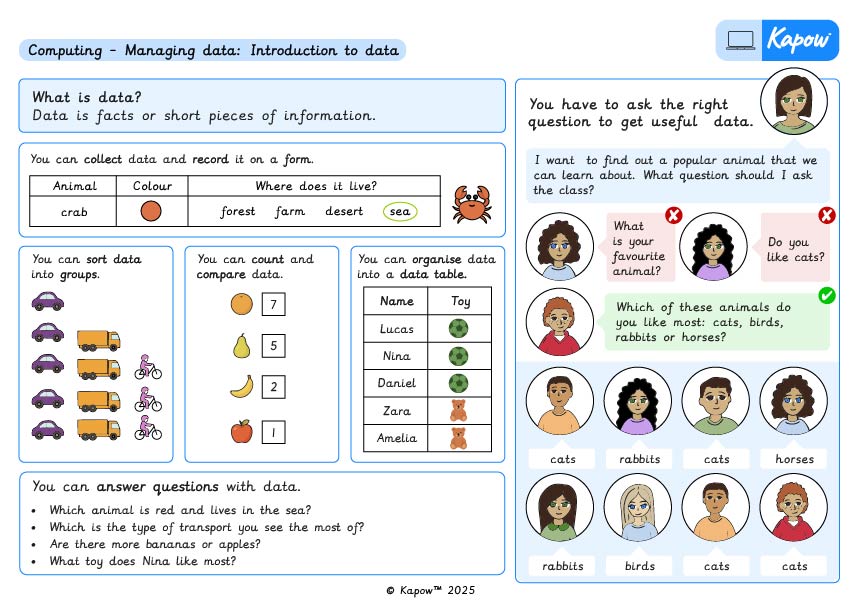
A knowledge organiser clearly displays key vocabulary and learning.
Knowledge organisers can:
However they are used, knowledge organisers are a valuable tool for supporting confident, connected learning in Computer Science.
A knowledge organiser is a helpful starting point when beginning a new Computer Science unit. Learners can scan the organiser in small sections, noticing any ideas or vocabulary that stand out. This activates prior knowledge and builds early interest in the topic.
Knowledge organisers offer valuable support for introducing and reinforcing computing terminology. They can be particularly helpful for learners with English as an Additional Language (EAL), providing a visual and accessible reference for key words. Learners can revisit the organiser as their understanding deepens, noticing how their vocabulary and confidence grow over time.
Used regularly, knowledge organisers help learners revisit and strengthen what they know. They can be used to:
Throughout a unit, learners can personalise their knowledge organiser by adding highlights, notes or examples that show what has been remembered or found useful. This simple approach helps learners reflect on their learning and develop a stronger sense of responsibility for their progress.
Towards the end of a unit, some children like to create their own version of a knowledge organiser, combining text, diagrams and key terms. This process helps them summarise their learning, demonstrate understanding and make connections between concepts.
Keep the organiser accessible — display a large version in the classroom and refer to it regularly during lessons. Make copies available during practical tasks to support learners as they work.
Incorporate the organiser into group or paired activities. Learners can match icons to vocabulary, use sections as discussion prompts, or participate in sorting and reflection tasks.
Send a copy home to help families understand what their child is learning. This can support conversations about learning beyond the classroom.
Knowledge organisers are working documents. They can be highlighted, annotated or adapted to meet the needs of each class and to reflect ongoing learning.
Knowledge organisers provide students in international primary schools with a practical and consistent way to strengthen their Computer Science education. By making key ideas clear, supporting vocabulary development and helping learners revisit prior knowledge, they create a solid foundation for progress across the primary years. Regardless of the Computer Science curriculum you use, knowledge organisers can enhance learning, boost independence, and help learners develop a deeper understanding of computing concepts.
